Death
Upright Keywords
Reversed Keywords
"Something must end so that something far better can begin — this is transformation, not tragedy."
Is Death a Yes or No Card?
The old form has to complete its ending before the new one can enter. If you know what needs to close, that is the door to Yes.
Meaning
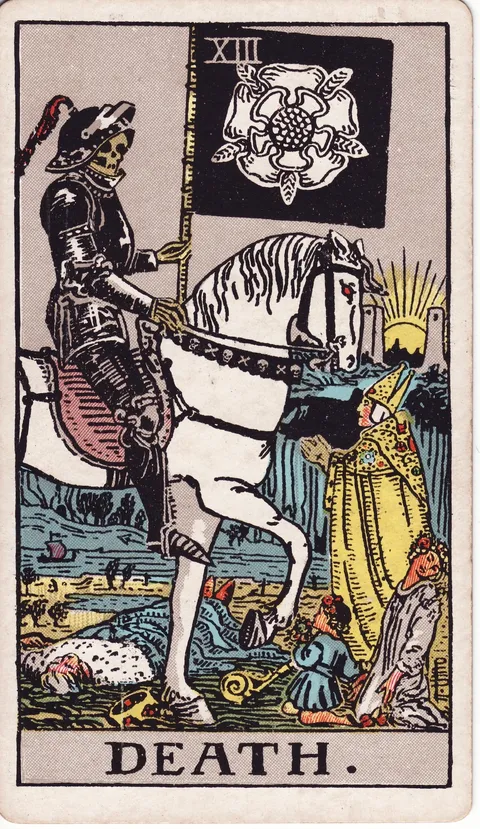
Death rides a white horse through a scene of surrender: a king has fallen, a child offers flowers, a bishop prays with closed eyes. In the background, the sun rises between two towers — there is always a dawn on the other side. This is perhaps the most feared card in the tarot and consistently one of the most misunderstood. Death almost never refers to physical death; it refers to the ending of a chapter, a phase, an identity, or a way of being that has genuinely run its course. The white horse is purity; the black flag with the white rose is life within darkness. The message is: real transformation requires real release.
Love
A relationship or romantic dynamic is undergoing deep change — and while that can be painful, the Death card asks you to consider that what's ending may need to end for both of you to grow. If a relationship has been over in every meaningful sense, this card confirms that it's time to complete it with honesty and care. If you're single, a previous version of how you seek love may be dying — which means you get to begin again, differently.
Career
A role, a career chapter, or a professional identity is ending. This may feel frightening, but the Death card's promise is that the ending is the necessary precondition for the next beginning. If you've outgrown your current position, the discomfort you're feeling is the signal, not the obstacle. What kind of work would you pursue if you weren't defined by your current role?
Money
A financial pattern, a long-held approach to money, or a particular financial situation is coming to an end. This may manifest as clearing debt, closing a chapter of financial difficulty, or simply releasing a money belief that was never actually serving you. What are you finally letting go of?
Relationships
Some relationships complete their purpose and need to end — not because of failure, but because of genuine completion. The Death card in a relationship reading asks whether you're holding on past the natural end of something because you're afraid of the grief, rather than because there's still something real to preserve.
Advice
Let it end. Grieve it fully, if you need to. Then turn toward the sun on the horizon — it's already rising.
"Refusing to let something die is keeping everything alive that needs to be released."
Is Death Reversed a Yes or No Card?
Resisting the change that is already underway is what is creating the block. The work is in not fighting what is already ending.
Meaning
Reversed, Death's transformation stalls. The white horse has stopped; the banner droops. You may be holding on — to a relationship, a career chapter, an identity, a belief system — long past the point where it was serving you. The resistance to change that Death reversed represents is always understandable, but it is always costly. The thing you're preventing from ending is preventing everything new from beginning.
Love
A relationship that has functionally ended may still be technically ongoing — through inertia, fear, or a reluctance to face the grief of loss. The Death card reversed gently but firmly points to the choice you've been avoiding. Keeping something on life support when it has already completed its natural course serves neither person.
Career
You may be staying in a role, a company, or a professional identity that no longer fits you because you're terrified of what comes next. The Death reversed doesn't promise the next chapter will be easy — it does promise that it cannot begin until you release this one. The stagnation you feel is the cost of not letting go.
Money
A financial pattern — overspending as a coping mechanism, avoiding looking at your numbers, staying in a money situation that hasn't worked for years — may need a real ending rather than another adjustment around the edges. Sometimes the transformation requires something more complete.
Relationships
The unwillingness to let a relationship change — insisting someone remain who they were five years ago, refusing to acknowledge that a friendship has naturally drifted — creates resentment on both sides. People and relationships change; resisting that process doesn't slow it down, it just makes it painful.
Advice
What are you keeping alive out of fear? Name it. The act of acknowledging it is often the beginning of the release.
Related Tarot Cards