Two of Swords
Upright Keywords
Reversed Keywords
"The swords are crossed, the eyes are covered — something is being deliberately not seen."
Is Two of Swords a Yes or No Card?
Eyes blindfolded, two swords crossed — a decision is being avoided. Opening the eyes and choosing a side is the condition.
Meaning
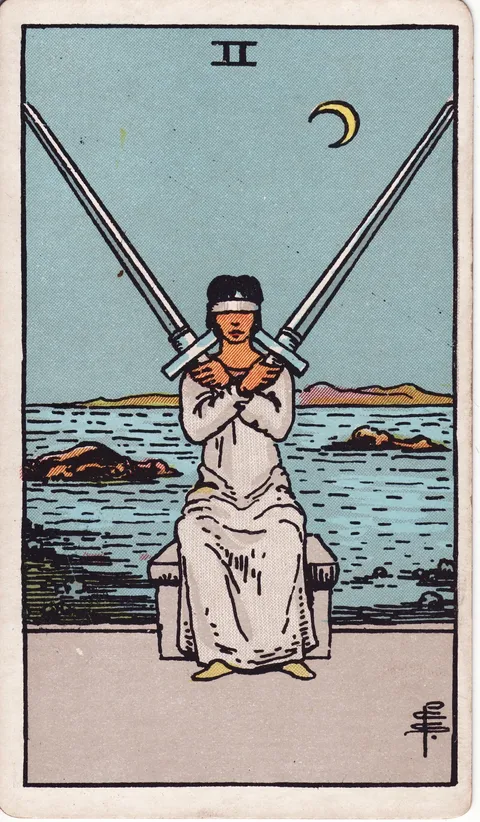
A blindfolded woman sits before a calm sea, holding two crossed swords in perfect horizontal balance. The moon rises behind her; a sliver of water is visible through the crossed blades. The blindfold is not imposed — she is choosing not to see. The Two of Swords is the card of the deliberately maintained stalemate: the decision you know you need to make but are holding at arm's length, the information you suspect is available but haven't fully looked for, the conflict you'd rather not engage because either outcome carries a cost.
Love
You may be in a romantic situation where you know more than you're letting yourself know — a dynamic you can see clearly when you allow yourself to, but that you're holding in suspension because neither option (staying, leaving, addressing the thing) feels comfortable. The Two of Swords in love says the balance cannot be maintained indefinitely. The swords are getting heavy.
Career
A professional decision between two equally weighted options — or between action and continued waiting — is being deferred. The Two of Swords in career readings asks whether the information you say you're waiting for will actually make the decision clearer, or whether you're using the need for more information as a legitimate-sounding reason to avoid committing. Sometimes the decision has to be made with incomplete data.
Money
A financial choice that requires trade-offs — two real options, neither perfect, both with genuine costs — is being held in suspension. The Two of Swords asks you to name what you'd choose if you had to choose today. That answer often reveals more than another round of analysis.
Relationships
An unresolved tension in a friendship or family relationship — something that neither person is directly addressing — may be creating a false calm that costs more energy than honest engagement would. The swords crossed in a truce eventually need to be lowered, one way or another.
Advice
Remove the blindfold and look at both options clearly. The discomfort of choosing is real, but the cost of indefinite suspension is accumulating. Decide.
"The blindfold comes off — what you see may not be easy, but it's true."
Is Two of Swords Reversed a Yes or No Card?
The blindfold is coming off and a choice is being forced. Hidden information is surfacing. Facing what you now see makes the decision possible.
Meaning
Reversed, the Two of Swords' carefully maintained balance shifts. Information arrives that changes the picture; the swords lower from their tense horizontal position; the choice that was being deferred becomes suddenly urgent. This card reversed marks the end of the stalemate — through revelation, through external pressure, or through the person's own decision that continuing to not-choose is itself a choice they're no longer willing to make.
Love
Something previously hidden or avoided in a romantic situation is now visible. This might be information you were waiting for, a truth you finally let yourself see, or a conversation that happened and changed everything. The Two of Swords reversed in love marks the moment when the situation becomes clear enough to respond to honestly.
Career
The information you were waiting for arrives, or the professional stalemate breaks — either because circumstances force the issue or because you've decided that clarity you create is better than clarity you wait for. Make your move while the opening is available.
Money
A financial decision that has been in suspension resolves — either because new information arrives or because the cost of waiting becomes greater than the cost of choosing. Act on the clarity before the window closes.
Relationships
A conflict that was being managed at a careful distance may need to surface and be dealt with directly. The Two of Swords reversed signals that the polite stalemate is ending and something more direct — and potentially more honest — is required from both people.
Advice
The information is available if you look for it. Make the decision that the situation actually requires rather than the one that creates the least immediate discomfort.
Related Tarot Cards